

So you want a new deck. Maybe you've started drawing ideas on the back of an envelope. Maybe you're about to ring around for designs.
Before you do, take a little time to check your block. Our advice is simple: do the checks first, and design second.
Here's why. When planning a deck in Avoca Beach, a few checks can change how big your deck can be, how high it can sit and what it can be made from.
Avoca has a few things going on. There's the lagoon, and Central Coast Council has flood-control processes in place for it. Council also lists bushland areas within some of the suburb's streets. And of course, there's the ocean right out front.
None of this means your block is affected. It just means it's worth finding out early. That way, your deck plans start with facts, not guesses.
This guide covers four checks:
- lagoon flood controls
- bushfire-prone land
- a short note for beachfront blocks
- the NSW rules for decks that don't need approval
At the end, there's a simple checklist. For each check, we show you where to find the answer for your own block.
This is general information, not legal advice. Always check your own property with the right authority.
Quick checklist: what to check before planning a deck in Avoca Beach
Short on time? Here are the main checks to make before you lock in a design. This list doesn't cover everything, so always check your own block.
- Look at your planning certificate. Your Section 10.7 planning certificate has a part called Chapter 9. It shows if your block has flood-related controls.
- Flood controls apply? Get more detail. Council suggests getting a Flood Information Certificate, booking a pre-development meeting, or both.
- Check if your block is bushfire prone. Look it up on the NSW RFS bushfire-prone map. On bushfire-prone land, a deck that doesn't need approval and sits less than 5m from the house must be made of non-combustible material. That means material that won't burn.
- Compare your plans with the size and height limits. For a deck that doesn't need approval, the limits include:
- no more than 25m² in area
- a floor no more than 1m above the ground as it is now
- no more than 3m at its highest point
- Check for public land. If any part of your deck sits on or over public land, you'll need special approval from Council or Transport for NSW.
Got a beachfront block? There may be coastal hazard rules to think about too.
Check 1: Is your lot affected by Avoca Lagoon flood controls?
Ask any local and they'll tell you the lagoon is a big part of Avoca. Council has flood-control processes in place for it. So before you plan a deck, it's worth knowing a bit about how the lagoon works, and how to check your own block.
How Avoca Lagoon behaves
Avoca Lagoon is the biggest of the four coastal lagoons in the Gosford area. It covers 97.5ha. On average, it's only 1.3m deep.
Most of the time, the lagoon is closed off from the sea. A sand bank, called a berm, sits across the mouth. It links Avoca Beach and North Avoca beach. The lagoon's let-out level is about 2m above mean sea level.
Council records show the lagoon was opened 58 times between 1976 and 2003. Most of those openings were for flood control. Keep in mind, that number only covers those years.
There were also some big ocean storms in May 1974, June 1978 and August 1986. During those storms, waves washed over the sand bank and into the lagoon. There is only limited data about these events.
Council has a flood study just for the lagoon. It's called the Avoca Lagoon Flood Study, and Paterson Consultants wrote it in November 2003. The NSW SES Flood Data Portal says it's older data that may have been replaced since.
How to confirm your lot's flood status
You don't need to guess whether flood rules apply to your block. You can check.
Start with your Section 10.7 planning certificate. This is a document from Council with planning information about your property. If your land is a flood control lot, the certificate will say so. A flood control lot is a block of land that has flood-related building rules.
Look at Chapter 9 of the certificate. It shows if your property has flood-related controls. If it does, Council suggests getting a Flood Information Certificate, booking a pre-development meeting, or both.
You might also come across the term flood planning level. On the Central Coast, this is the 1-in-100 chance flood level, plus an extra safety margin called freeboard. The flood planning rules are in clause 5.21 of the Central Coast Local Environmental Plan.
Want to read more? See Central Coast Council's guidance on building in flood zones.
Our tip: get this sorted before you pay anyone to draw up plans. It's much easier to design around the rules from the start.
Where to check
Section 10.7 planning certificate → Chapter 9 → if flood controls apply, a Flood Information Certificate, a pre-development meeting with Council, or both.
Check 2: Is your property bushfire prone?
Avoca isn't just sand and water. Plenty of locals have bush close by too. Council's 2025 community land list includes several “Natural Area – Bushland” parcels inside the suburb, spread across a number of streets.
But living near bush doesn't tell you if your own block is bushfire prone. Council says the NSW Rural Fire Service (RFS) has marked many Central Coast properties as bushfire prone. Council also says this doesn't always mean there's a big risk.
The only way to know for sure is to check. Look up your block on the NSW RFS bushfire-prone map.
Why does this matter for your deck? It comes down to one NSW rule. On bushfire-prone land, a deck that doesn't need approval and sits less than 5m from the house must be made of non-combustible material. That means material that won't burn.
This can change which materials you look at for a deck close to the house. So if you're thinking about composite decking options or hardwood decking, check your block's bushfire status first. Then find out how that status affects the materials you can use.
Our advice: don't fall in love with a material before you've done this check. It can save you a change of plans later.
Building within 5m of the house on bushfire-prone land?
A deck that doesn't need approval must be made of non-combustible material.
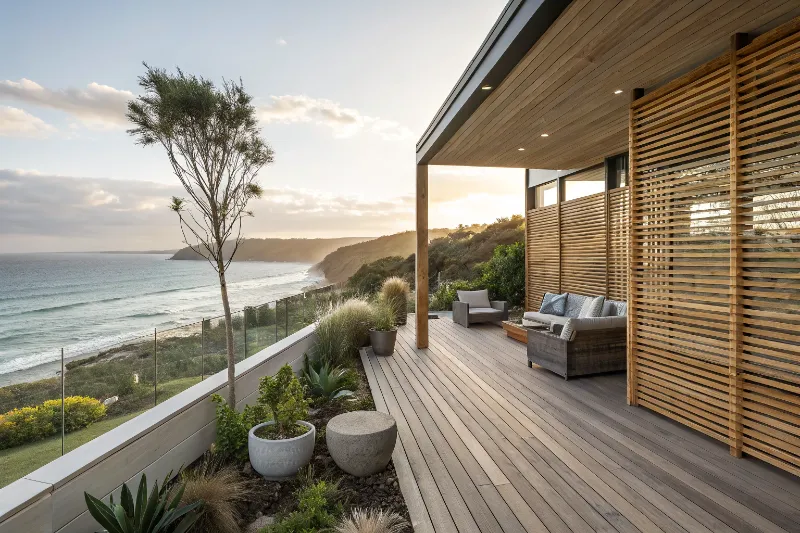
Check 3: Beachfront and near-beachfront lots
This one is short. It only matters if your block is on the beachfront or close to it.
Council records show the worst storm erosion on this part of the coast hit The Entrance North, North Avoca, Terrigal and Wamberal beaches. That was in 1974 and 1978, and to a smaller extent in 1986. North Avoca shares the same stretch of coast and the same lagoon sand bank as Avoca Beach.
If you own private land, you can only build coastal protection works with development consent. This is under the Coastal Management SEPP, which is a NSW planning policy for the coast.
Beachfront blocks can have coastal hazard planning rules to think about. If that's you, find out what applies to your property before you start on a design.
Check 4: Will your planned deck stay within exempt-development limits?
Some small building jobs in NSW don't need planning approval. This is called exempt development. But your deck only counts if it meets a set list of rules.
In NSW, a deck must stay within limits that include:
| Exempt limit | What to compare it against |
|---|---|
| Area: no more than 25m² | The total size of your planned deck |
| Floor height: no more than 1m above the ground as it is now | How high your deck floor will sit above the ground today |
| Highest point: no more than 3m | The height of the tallest part of your deck |
These aren't the only rules. You can read the full list in the NSW Planning Portal's exempt development rules for decks.
Two other rules also apply. On bushfire-prone land, a deck that doesn't need approval and sits less than 5m from the house must be made of non-combustible material. And if any part of your deck sits on or over public land, you'll need special approval from Council or Transport for NSW.
If your deck doesn't meet these rules, it isn't exempt development. That means a different approval path applies.

Height limits really come into play if you're dreaming of multi-level deck designs or a raised deck. Do this check at the same time as your flood and bushfire checks. That way, your custom deck design starts with the right information.
Our view: it's better to know where you stand on these limits before the design work starts, not halfway through.
Before you start designing: bringing your checks together
Done your checks? Great. You'll now have a much clearer idea of what might shape your deck. Here's a simple summary to keep handy.
| Check | Where to confirm | May affect |
|---|---|---|
| Flood controls | Chapter 9 of your Section 10.7 planning certificate; a Flood Information Certificate, a pre-development meeting with Council, or both | The flood-related rules that apply to your block |
| Bushfire-prone status | NSW RFS bushfire-prone map | Material choice for a deck that doesn't need approval and sits less than 5m from the house |
| Beachfront blocks | Your property's planning information | Coastal hazard planning rules |
| Exempt-development limits | The NSW Planning Portal's exempt development rules for decks | Deck size, height and approval path |
| Public land | Council or Transport for NSW | Whether you need special approval |
Remember, this guide is general information, not legal advice. Always check your own block with the right authority.
It can help to have your certificate results ready when you start talking about a design. Once you know where your block stands, we're happy to talk through designing and building a deck for your Avoca Beach home.